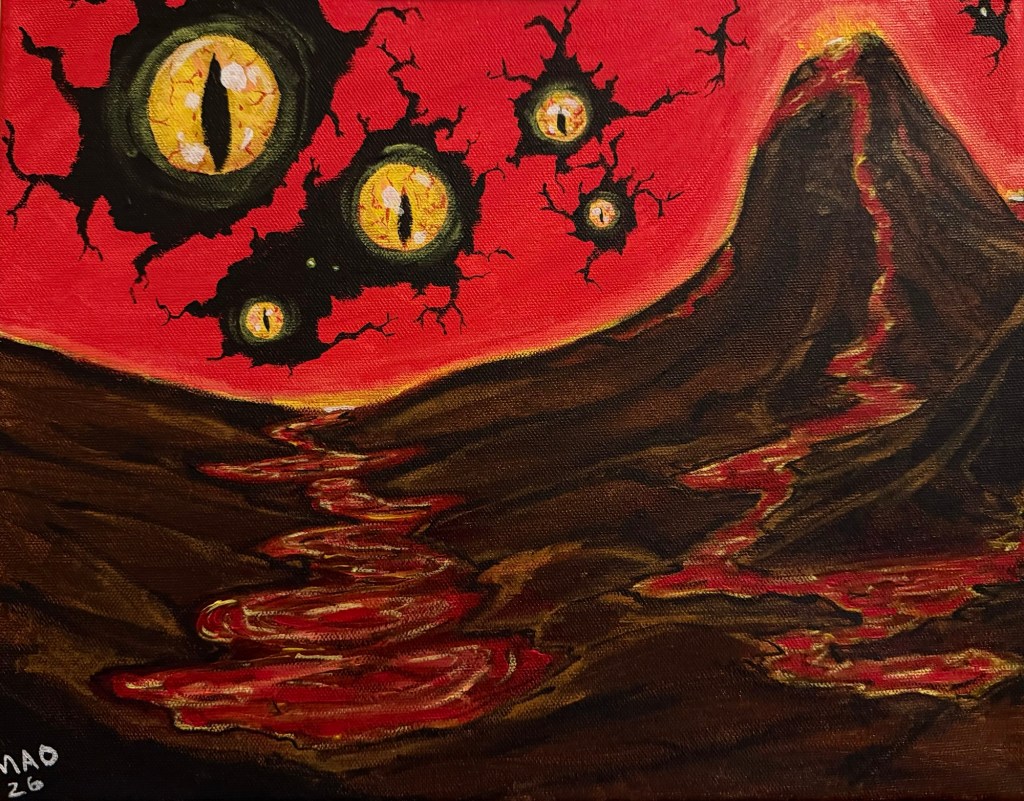
Okay, another one down! Two more to go.

Okay, another one down! Two more to go.
Flower Sauron? Hrm..
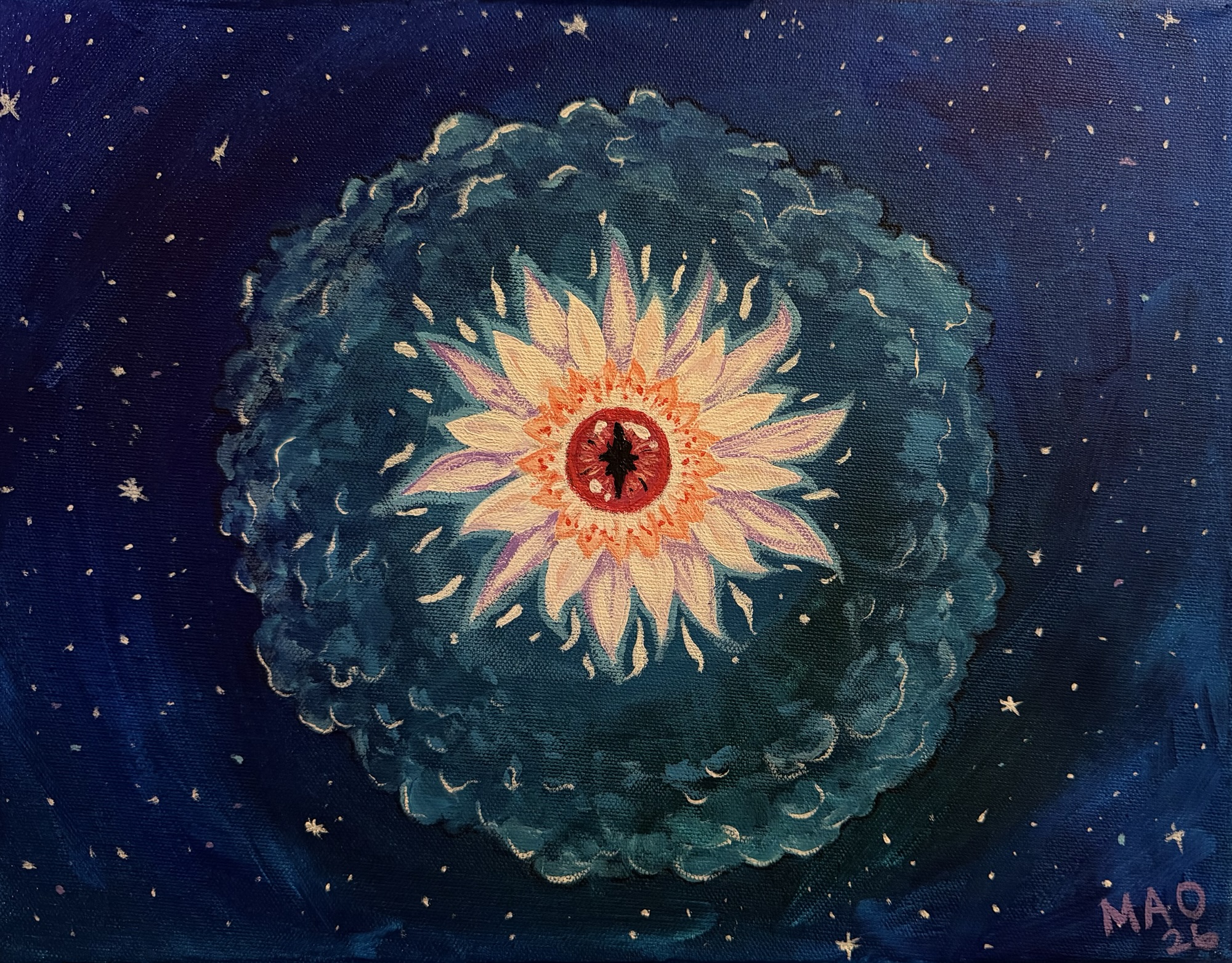
Surprise surprise! I have basically fallen behind this month. Oops. Anyhow, I don’t intend to do less paintings before the end of February, so here is the second – which leaves three more. Whee!
For February of this year, I’m challenging myself to do a large’ish painting once a week. I’m starting very early with the first – I’m not sure if the plan is to do 4 and I’m starting early to give myself leeway, or if I’ll do 5 (1st, 7th, 14th, 21st, and 28th). I guess we’ll see!
Anyhow, one for the Chinese zodiac year!
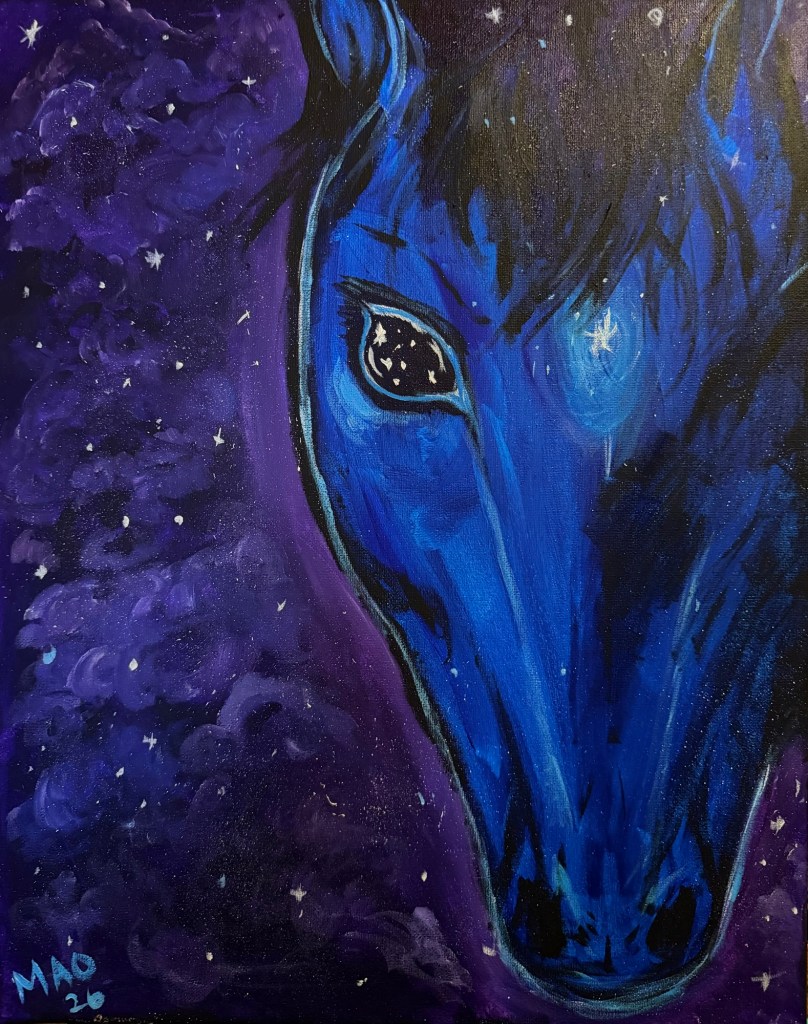

Started this last year for the year of the snake, but did not finish until now owing to… things. 😅
Life goes on.
All right! So this past year I was attempting to get to 30 books on BOTM’s reading challenge, so many of the following are books I received through that subscription service. I got a bit derailed (from everything really) in March, but still attempted to keep going, and didn’t really taper off until I hit October. (September and October tend to be my “give up” months for challenges, if anyone hasn’t noticed the pattern). As a warning, many spoilers beyond for all of the books mentioned as I challenge myself to even remember and summarize what I read through the year!
Project Hail Mary by Andy Weir
Although not as compelling as The Martian, I really enjoyed this one. I didn’t find out until after reading it that there’s a movie on the way as well, and I’m pretty excited about it. The sun is dying, and scientists discover that the reason is because a tiny alien species is devouring it. Tracing a path of dying stars, they find that origin system for the creatures has a healthy star, and they decide to put together a mission to find out why that one in particular has survived. The main character is a science teacher who gets tangled up in the mission as an advisor and trainer for the scientists they plan on sending, until a massive accident results in him being sent along. He wakes in an alien solar system only to find that the rest of the team is dead. Since he’s Earth’s last hope, he doesn’t give up – he works diligently to find out why this star is fine. While there, he meets another intelligent alien, and they begin to communicate with each other. As it turns out, this alien’s home world is also experiencing a similar problem, and he is also there to try to save his home. Similarly, his entire crew died on the way. As it turns out, they didn’t have a full understanding of the dangers of space travel, and they all died because of radiation – as the engineer, the surviving alien was often in a more shielded part of their ship, and thus managed to avoid getting sick. Together, they find out that the reason the tiny sun-devouring aliens haven’t consumed their home sun completely is because they have a natural predator in the environment that keeps their numbers manageable.
Like the Martian, everything is well written, and the character has an amusing enough voice that keeps you engaged throughout. The science in this feels less solid than it did in the Martian, but everything is very reasonable. Throughout the book, the main character is trying to remember how he ended up on the mission, and by the time he’s found out he’s still too devoted to the mission to really do anything about his anger. Him and the alien work through everything, find a solution, and start to return home, but he realizes that his new friend is going to die without his help. He still manages to send his results home, and detours to help the alien, but this means that he’s stranded and unable to return to Earth. He still manages to make a new life for himself in a special habitat the aliens make for him on his friend’s home planet. The ending does almost feel too cutesy, but as far as endings go wasn’t horrible.
This Inevitable Ruin by Matt Dinniman
A holdover from 2024 when I was reading through the entire series. In this one, Carl and Donut are completely in the Faction Wars floor. Instead of players being used by the existing Factions, Carl has managed to become the leader of his own faction, and has also gotten the NPCs a spot of their own as well. The rules have also been changed so that the people outside of the game that have joined Faction Wars are actually at risk of dying. They’ve also got a whole army of volunteers from previous games who have joined to help.
This book also included small snippets of other Dungeon Anarchist Cookbook authors and their “inevitable ruins” – some of them within this present Faction Wars as some of them are volunteers that return to help Carl. It makes a lot of it very bittersweet. Also this is where I caught up with the series – the next book isn’t quite out yet, but I’m looking forward to it quite a bit.
Margo’s Got Money Troubles by Rufi Thorpe
Margo is a young woman who goes to college and gets pregnant while sleeping with one of her married professors. He doesn’t want to mess up his marriage, so he breaks things off with her and his mom pays her to not mess with him. Her own mother has very little interest in helping to take care of a baby and very vocally tells her daughter so upfront. Her roommates are also college students, and because they did not sign up to live with a baby, they both move out of the apartment. Margo is very ill prepared for motherhood and has no support system. Her boss gives her an ultimatum to take a weekend off and find someone to watch her kid so she can work – she can’t, so she’s fired. Without roommates, the total value of the rent is on her.
At this point, her father re-enters her life. He is an ex-professional wrestler who has been in and out of rehab for addiction. Margo and her mother were always his “other” family – he would come to visit whenever he was doing shows in their town, but always returned to his wife and kids. He’s finally divorced his wife and was going to propose to Margo’s mom, only to find out she has a fiance now, so instead he shows up on Margo’s doorstep and asks for a place to crash. He seems thrilled to help his daughter with a little bit of rent money and taking care of the baby.
Margo hears about OnlyFans and decides to give that a try. She begins pretty good but isn’t making as much as she wanted, so she confesses what she is doing to her dad and asks for his help in coming up with ideas. At first he’s disappointed in her, but eventually comes around to seeing it as a “show” like wrestling, and advises her to create a character and reach out to other content creators so they can make videos where their characters interact. Margo comes up with a weird alien girl who is always doing slightly odd stuff as she learns about Earth.
The videos really take off and Margo begins to make pretty good money, but when the professor finds out that she is making OnlyFans videos he becomes concerned about the environment that his child is in and calls CPS and challenges her for custody. She does get everything worked out in the end though. Oh, there’s also a love story thrown in where one of the dude’s sending money on OnlyFans chats with her and they fall in love and meet. And her dad relapses but they work out a good rehab plan for him.
It’s not too bad of a story, but the main character is so naive at times. Mostly it’s because she’s young, and perhaps a lot of that is very true for someone that age, so maybe I’m having trouble relating because I’m older now. The friendships and party habits were also a bit annoying to me, and the ending felt too neatly tied up for everything that happens within the story. I can’t remember whether the baby even felt relevant beyond set dressing for the story?
Honey by Isabel Banta
The premise is that it’s the late 90’s/early 00’s and a young girl rises to pop star fame, and what that does with her life. Considering the time frame, I was expecting more media frenzy and slut shaming and exploitation, because that was a lot of the problematic issue for young pop stars of that time period (think Britney) and while it briefly touches upon some of that, it wasn’t really the main focus of the story. I think the main focus was her big crush on some guy and trying to get that relationship just to find that it didn’t really fit what she was thinking it would be, and how the love triangle aspect kind of embittered her one important friendship. And a lot of the issues and things described felt more like modern day problems than problems of that time frame.
Anyhow, the main character matures and then develops a relationship with a producer and they make great music together and she gets herself on track or some shit.
The records on the cover are arranged the way they are because her only definable personality trait is big boobs.
Sleep Tight by J.H. Markert
I honestly can’t remember much about this.
There’s a killer. I think the main character is a cop? Her son goes missing? The killer is making it like her dad’s old murders, or like the murders of someone her dad caught? It was pretty generic thriller stuff. I don’t remember liking it or hating it. It just was.
Ready or Not by Cara Bastone
This one is a pretty generic love story. Woman gets pregnant by one night stand, finds out the father was just on a break with his ex and is already back together with her, so she’s going the single mother route. Her best friend’s brother, who she’s known her entire life (and – surprise – has always been in love with her) steps up and helps her out along every step of her pregnancy. The father also wants to be a bit involved, but it causes some drama with his girlfriend. The main character helps him to see that his girlfriend is actually a bit too controlling and that he doesn’t really want to be with her. Over the course of the pregnancy, she falls in love with the childhood friend’s brother and they move in together to be a happy family at the end.
I do remember that the main character has author voice sometimes, where it doesn’t quite fit the story to have a certain moralistic liberal idea but the main character decides to lecture people on it so that the author can make it very clear where she stands. I lean liberal, and I don’t mind when the ideas are presented naturally, but I dislike when characters just feel like a mouth-piece for ideology.
Regardless, it’s a cute story and there’s a nice little sex scene in it.
You Like It Darker by Stephen King
Spotted it in the store and decided to take a break from BOTM books. For one, the title is inspired by a song I like, and for another, it’s King. That being said, none of the stories are darker than usual for King. If anything, a lot of it feels like a rumination on getting old and dying alone or with a sense of failure. The opening story especially stood out for me in its contemplation of whether success can be had without at least a core of talent. Another stand out for me was a story that kind of re-does “A Good Man is Hard to Find” by Flannery O’Conner, though that might be because I had to read it about three or four times in college. In that story, an old woman gets her son’s family lost and killed by robbers during a road trip. In King’s take, an old man saves his family in a similar situation – it definitely had more a “feel good” feel than most of the rest of the book and its inspiration.
I mean, it’s Stephen King. I liked it.
Dragonfruit by Makiia Lucier
Mixing Western style fantasy with a Pacific Island aesthetic. The main character is a girl who’s father was banished for using a dragon’s egg to save her from death, when it could have been used to save the island’s princess. Her father dies after, and she tries to find an egg to take back to her home. While following a seadragon that is showing signs of laying an egg soon, she ends up back on her home island – she is welcomed back, but there is a little bit of drama. She and the prince go on a mission to find the eggs across the island.
There are some fun ideas at play. For one, there is a certain magic that only works on her island for her own people, where a tattoo appears on their skin that can come to life and aid them in ways throughout, and her own appears at the end of the story. She also has a connection with seadragons because the egg of one was used to save her. I remember that there were also people that were “European” that were visiting as well (in quotes, because it was a fantasy world entirely so they weren’t really European, per se).
It did take me awhile to get through it, because it was easy to put down and not pick back up. But it was a fun story when I was getting into it.
Final Girls by Riley Sager
In this book, there are three women who survive similar horror movie situations where they were the sole survivors. One of them suggests meeting for support, but the other two are reluctant. One day, the initial one that suggested the meeting ends up dead, which prompts the more mysterious person to approach the main character.
It’s a thriller. I guess I’m not as super into them? Sometimes they come together really nicely, and generally Riley Sager is very popular and manages to not make things too predictable or eye rolling most of the time. This is also one of Sager’s more popular novels. I think I had heard so much about it being so great beforehand that I was a little disappointed in the end. I don’t remember a lot of it to be honest, but I do specifically remember the ending as being annoying. The main character hears about a young woman (a teenager, really) that has gone through a horrible thing and has become the sole survivor of that event. She goes through great lengths to travel to her and sneak into her hospital room to introduce herself and offer support as a fellow final girl. And it just struck me as… creepy?
But if you like Riley Sager, you’d like this.
Liquid: A Love Story by Mariam Rahmani
I disliked this one.
The main character is kind of arrogant, an intellectual with a PhD that seems to look down on American culture despite being so obviously entrenched in it. The core love story is obvious – she’s in love with her white college friend, but he keeps breaking up and going back to some other girl. She doesn’t specifically say that she loves him, and he doesn’t reveal until the end that he’s loved her all along, but it’s very apparent that’s who she’s ending up with. She decides she wants to marry rich and as a matter of math, decides to limit herself to 100 dates after which she’ll pick the person from the 100th date and marry them. She goes through a series of dates and one night stands, some kind of awkward, some already married, some not good fits. In the middle of the book, her father gets sick, and she travels to Iran to help care for him. While there, she has a romance with his neighbor, an artist. The artist introduces her to her friend group while they are seeing each other.
Her father dies and leaves her his house and belongings in Tehran. She considers living there at first, but some of the realities of life there begin to hit her. The liberal queer group of her artist are all wealthy and intellectual, but seem to look down on her and treat her like a child, which chafes for her. She attempts to find books to perhaps help with her research in a project she is interested in writing, and the books are banned (she still gets them, just that it becomes a longer conversation wherein the bookseller seems to decide whether it is all right to trust her with the sale). After deeply considering what life there may be liked for her, she decides to end things with her artist girlfriend and returns to the United States, leaving renting the house to an uncle.
Back home, her college bestie seeks her out and reveals his feelings and that the poems he writes are all about her. While it is a very good book, it was hard to tell if the main character absorbed a lesson, but I feel that I might be judging it a bit on the harsh side owing to my general dislike of her.
Five-Star Stranger by Kat Tang
This one has kind of a fun concept – there is an app where people can rent the services of other individuals to arrive and pretend to be a relationship of some sort. If you need someone to go to a funeral and act a certain way, or a charming date to a family gathering, you can use this app to find that person and pay them for a few hours of their time. The main character is a guy who is very highly rated on the app, and he has built his entire life around having an entirely professional demeanor in regards to his job – he doesn’t let personal feelings get in the way, and he doesn’t engage in sex because its serious work for him. One of his regulars is a woman who has hired him to come visit once a week and pretend to be her daughter’s dad – she is a single working mom but wants her child to grow up with a father figure. They’ve concocted an entire story over the years of him having a job that keeps him away for the entire week. The girl is getting older, and he finds himself actually caring for her in a paternal matter. He has also recently taken a job pretending to be the brother of a girl in college. She is attempting to write a fictional story but having trouble relating to her characters, so she hires him to act like the brother acts in her story, to have a “first hand” feel of what it would be like. She also tries to discuss what his job is like with him and learn about him as an individual beyond the role she hired him for.
These things are challenging his professionalism. We also get insight into his relationship with his mother when he was younger, and how that affected his ability to form interpersonal relationships. Sex is a weird taboo for him because he relates it to something that caused loss for him before, and now it feels wrong. His entire apartment is composed of just different clothes for the different roles he might have to play. But the relationship with the girl and the fake sister kind of help draw him out of that.
I can’t really remember the ending, but I remember really liking this one. The main character tries to put up very strict boundaries because of his own personal issues he doesn’t want to face, and feels more comfortable playing roles than being himself, and he really grows past that.
A Flicker in the Dark by Stacy Willingham
I don’t really remember this one too well either, but I do remember looking at other books by the same author shortly after, so I must have liked it well enough.
Dearest by Jacquie Walters
So this one is hard for me to say whether I liked or disliked. It starts off slow and almost like a more deep/arty look at postpartum, where a new mom that is home alone waiting for her deployed husband to return begins to experience weird things. She sends an email to her estranged mom, who shows up and helps her a little. She starts seeing her childhood imaginary friend again too.
And then her husband returns and it gets a bit weird because it turns out her mom has been dead all this time. And then it ramps up until there are actually demons and a monster pops out at the end to kill her.
The way the first half is written is so much like it’s going to be about postpartum that the last half threw me. I kind of disliked the first half and that made me unprepared for how it was actually going to go. You spend so much of the first half thinking she’s just in her head that when it’s bam! real monsters, it’s a bit jarring. I have the feeling I would have liked it a lot better if I had taken her mentality at face value rather than trying to read it under a lens, I guess?
The God of the Woods by Liz Moore
So I’ve gone on and on about not liking thrillers, but here is one I really liked. A rich family owns a summer camp, and one summer their daughter goes missing at the camp. It turns out her younger brother also went missing years ago, and the person that went to jail for that has recently escaped jail. What follows is a look at the interpersonal dramas of each involved.
I think I particularly liked how this ended also. The idea that the girl’s family was too toxic for her to be around and she wanted to escape before she was a legal age to escape, and the end revealing that she is safe and happy just waiting out her time.
Dark Matter by Blake Crouch
This was a re-read because I had a BOTM edition and I wanted to actually read it before giving it the rating to add it to my challenge. I remember really loving this book when I first read it, so much that I immediately recommended it to my closest friends. All of Crouch’s books have been pretty good, but this is probably the best. It starts out with an idea that is fairly stereotypical – two roads diverged, the guy who chose family has been stuck wondering how far he could have got and feels a bit disgruntled with his life, the guy that chose career has made great discoveries and is very successful but wonders “what if” about the other life. He kidnaps and switches spots, thinking he’s doing the family guy a favor. What follows is an interdimensional journey where the one is trying to get back to his family, and we get glimpses of many different worlds.
That in itself is fun. And of course, he gets home. But then what happens?
The story takes it a step further, in a completely logical manner. It’s a multiverse, and there’s many version of him that took different paths and opened different doors on their journeys home, and they’re all arriving to try to get back to his wife and son, and craziness ensues.
There are a lot of stories that would just have had the two guys duking it out, but this took this one logical step further that makes great sense, fits the narrative, and makes it really stand out against other similar stories. And the many variant apocalypses they run across initially are fascinating to see as well.
I loved it then, I still enjoyed it even knowing what was coming. There’s a show, it’s also great. Read it, watch it, I highly recommend all.
American War by Omar El Akkad
I took a brief break from my BOTM books, although I initially found out about this book by browsing the BOTM app. However, it shows as sold out and has never been re-offered by them since I’ve added it to my reading list, so I finally just got it another way to read. It is set in the future, about another American Civil War and some of the specifics of it in relation to the life of a young woman who plays a large role through some of the war, and especially the major events at the end of it. Some of it still feels a bit relevant, though the concerns of the time frame that it was written in kind of date it a bit. That being said, it’s an interesting glimpse into a future where America is collapsing and dividing, and I think the big end event is an engineered virus?
There were bits that were fascinating, but as I mentioned, it feels a bit dated compared to current concerns and some of it was just… boring. Which it seems should have been hard to manage given the subject matter, but it was more concerned with how prescient it could be, I suppose?
Iron Flame by Rebecca Yaros
Second book in The Empyrean. It’s a fun enough series featuring dragon riders and a few smutty scenes. The main argument the characters keep having feels stupid, but anything for tension. He’s graduated but she’s still in school, so there is still the “university” feel to it with training and classes. If it’s your thing, it’s your thing, and if it’s not it’s not.
The Names by Florence Knapp
I loved this one. It opens with a woman taking her son to register his name, and finding herself stuck between three choices – naming the child how her abusive and controlling husband wants, naming the child how she wants, or letting her daughter name the child. The book then diverges showing the life of each child depending on the name that she has chosen, and each is quite drastically different. It was beautiful and contemplative and a little sad. I definitely recommend it.
Yours Truly by Abby Jimenez
There’s less letter writing than you would think for this one. Anyhow, it tries to be enemies to lovers, but like usual, they’re not mutual enemies. The guy, as always, is head over heels first and the girl is just misunderstanding him. Once they get past that, they’re great friends. It turns out he’s a match to be an organ donor for her brother, and because his ex is marrying his brother, he asks her to play the part of his “new girlfriend” that he’s lied to his family about having. They grow closer, and the only misunderstanding that keeps them apart is her thinking that he’s in love with the ex still, which of course somehow doesn’t get explained until the end. Then they happily ever after.
As mentioned, the title suggests more epistolary than it is, but it’s fun and cute. Apparently it is also part of a trilogy, and it does have me interested in reading the others.
Next to Heaven by James Frey
A bit caught up in its artsyness but I didn’t mind it. The characters are wealthy couples in an upscale community who decide to arrange a swinger’s party, but everything about it is all planned from the get go, and a lot of things after are also all part of a plan. It comes together really well, and a lot of pieces are planted with care for it.
Among Friends by Hal Ebbott
Kind of disliked this. So these two guys have been best friends since college, and as a result their families are close and meet together a few times a year. They each have beautiful wives and teenage daughters. During one of these get togethers, one of the guys pins and gropes the other guy’s daughter. The girl keeps it to herself at first, beginning to act out in other ways, but when she gets caught shoplifting she confesses everything to her father. Her father instantly believes her, but everything gets muddled because her mother doesn’t believe her and the guy insists he did no such thing.
For a moment the book plays with an alternative future where her father separates her from these people in order to ensure her safety and to assure her that he is 100% on her side. But then it cuts back to the reality that he is not wealthy and needs his wife’s support to have the life he has and he doesn’t want to cut off his best friend, so the end of the story shows him dragging his daughter back to another get together with the friend’s family, and nothing is ever done about it.
A lot of the book also just revolves around everyone’s negative thoughts and feelings about each other – about their kids, about their spouses, about their friends. Nobody really likes each other, they’re all annoyed at each other, they’re all miserable people.
It was kind of unpleasant.
Don’t Cry For Me by Daniel Black
This is a series of letters from a father to his son discussing the events of his own life and some of how his relationship with his son was framed by the events of his life and his understanding of the world. He is estranged from his son because of his dissolved relationship with his wife and because of how he could not relate to his child. A lot of that estrangement surrounded his son’s being gay, and how his son failed to be as manly as he had been raised to expect men to be. It is mostly an apology for not being more understanding, because the father is on his deathbed and plans to leave the letters to his son.
I enjoyed it. Sometimes with things like this I always get pulled out a bit because of voice. We’re talking about an older gentleman that was generally illiterate and only took up reading and writing later in life. I don’t mind grammar and spelling being nice enough, but sometimes word choice and how artfully something is shared seems to shift me out and wonder if that is how the character would really phrase these things.
Isaac’s Song by Daniel Black
The follow up to Don’t Cry For Me, Isaac discusses his reaction to finding the letters that his dad left, and his relationship with his father and how it was for him growing up as a young gay black man within the time frame of the late 80’s.
Not bad, it’s quite interesting, some of it is also about finding one’s voice and art. I can’t remember what Isaac’s art that he wants to share is at the end though, there is so much that he does throughout the book (he plays piano, paints, and writes). But he’s got a weird relationship with art because his father never seemed to approve, and so he got a degree relating to computers and works in a cubicle.
Some of it is as much about being black as it is about being gay. I do remember one specific scene where they’re at a work Christmas party and he’s singled out by someone wanting him to get on stage and sing because all black people are musical, right? Right? He hard refuses and him and the other black guy at the party commiserate a bit about the expectations that people have based on race.
Anyhow, shortly after settling his father’s things, he tries to find his relationship with art again. A lot of it involves him speaking to his therapist too.
Play Nice by Rachel Harrison
This isn’t too bad but I do remember thinking that it could have been better if the author had fully committed to fleshing out the book within the book and making it less generic. As it is, the book within the book is just there as a plot device and the bits shared with it feel like they’re just getting information out there. Granted, fully fleshing it out might have expanded the novel quite a bit, but I’m not afraid to read a 500 page book if it’s done well.
It’s a demon haunting tied to a house and a girl. She inherits the house after her estranged mother passes, decides she wants to document her process improving it and flipping it and then selling it at a profit. Weird things begin to happen, because there is an actual demon involved, and she realizes she can’t sell the house.
I liked it. Like I said, I felt like more could have been done with it. I could have liked it better.
Divine Rivals by Rebecca Ross
If you’re looking for non smut romance fantasy, this might be up your alley. It has a kind of You’ve Got Mail feel if the characters immediately shipped out to WWI, and if the WWI was a fantasy one involving gods and monsters. The magic is interesting and the world building is great. I quite enjoyed it, and I’m in the middle of the second book at the moment.
The Ten Year Affair by Erin Somers
A man and a woman meet at a baby group after they move to a small town. They become friends and almost have a fling, but realize that would ruin things for their happily-married-with-two-kids lives. So instead they introduce each other to their spouses so they can all be best friends and begin to hang out together. Over the next several years, the woman has a normal friendship with the man but has an entire imaginary world built around them having a torrid affair. One day, the lines actually do cross, and they actually do start to have an affair in real life. The woman’s daydreams begin to focus on reconnecting with her husband and family.
Also, the affair being real is less exciting for her than when it was a fantasy and she finds herself less attracted to her lover. Both marriages suffer a bit when the truth comes out. Her husband implies that he always knew but didn’t want to make a mess by revealing, and the other couple divorces and the wife moves away. I can’t remember if she stays with her husband or not, but she does come to see some of the issues with the guy she’s cheating with, so she doesn’t choose him in the end.
Some of it reflects on living through COVID. I did kind of like this one. I didn’t fully like the characters, but they were relatable.
Butcher & Blackbird by Brynne Weaver
A romantic comedy featuring serial killers. It was written in a manner that made it a fast read, but was kind of disappointing for what I was expecting. I mean, serial killers and smut? Sounds amazing. But the smut doesn’t start until late into the book (although there are more than one smutty scene at least). And the serial killers are just basically Norman Bates, Hannibal Lecter, and Leatherface from Texas Chainsaw Massacre. They’re given new names but the settings and characterizations are basically the same as the movies they’re from, and our lovebird serial killers (serial killers that target bad people and serial killers) are just pitted against them on their playing grounds as part of their yearly game to see who can find and kill the killer first.
It makes it a bit more boring than what I was expecting but I will read the other two books, although from what I can tell they mostly just focus on showing the specifics of the relationships of all the brothers. I’m not in a rush to finish this.
Carrie by Stephen King
So, when it became clear I wasn’t going to be finishing my BOTM reading challenge this year, I took a break and finally decided to do a Stephen King run. I’ve read half of his books, but not all. I decided to challenge myself to read just his novels over the next year, starting chronologically with Carrie.
Carrie is the tale of a high school girl who discovers she has telekinetic powers. She is bullied by her schoolmates and terrorized by her mother, but after being asked to prom, she lashes out at her mother. Prom seems to go well for her until a classmate’s prank causes her to snap and then she walks across town, causing chaos – starting with burning down the gym with half of her class locked inside, then emptying the fire hydrants and opening gas lines causing multiple explosions across town. Her religious mother attempts to kill her.
Most of the story is told through interviews, articles, book excerpts, and reports written after the event. Carrie’s openly strong telekinetic abilities are studied at great length, and it is discovered it is a recessive genetic trait that skips generations in women.
It’s a short fun novel, and it introduced us all to the King.
And I’ll be reading a lot of King this year. I’m skipping Dark Tower, because I want to read the entire series in a row, and I am skipping the short story and novella collections, mostly just going down wikipedia’s list of novels. I also watched the old and new Carrie movies after reading the book. Just finished Salem’s Lot, but that will be part of next year’s write up.
Happy New Year!
 mehryment